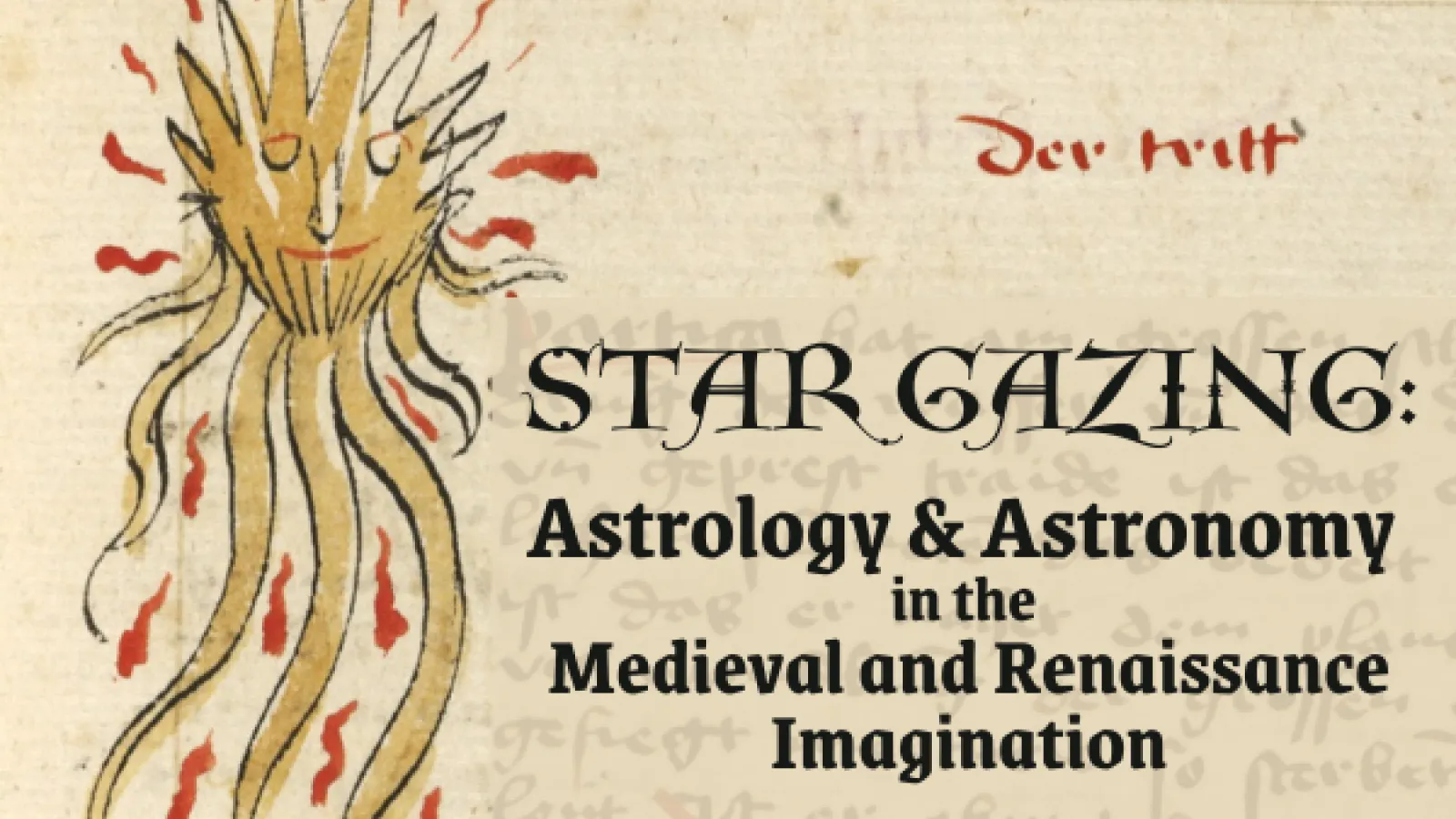
Since human beings first looked up at the heavens, the stars and other celestial bodies have played a crucial role in how people have made sense of the cosmos, their societies and the bodies they inhabit. This year's biennial celebration of Popular Culture and the Deep Past (PCDP) centers on the topic of “Star Gazing: Astrology and Astronomy in the Medieval and Renaissance Imagination.”
As in past years, this event will feature a scholarly conference with papers, round tables and keynote lectures by prominent scholars, nested within a Renaissance-faire-like carnival featuring exhibits, live demonstrations and activities of all kinds.
This event encourages participants to blur the boundary between what is too easily characterized as an older worldview based in astrology and other superstitions, and the apparently more rational and proto-scientific worldview of astronomy that championed empirical observation along with new techniques and instruments. It will be fascinating to learn how these two systems overlapped and informed one another both in practice and across a range of representations like art and literature. Astrological beliefs and practices live on into the present and still shape the way many of us see reality.
The PCDP conference generally holds paper presentations on the Friday of the event (April 10). Additional presentations are scheduled in tandem with Saturday's mini Renaissance Fair (April 11) that will otherwise feature a variety of exhibitions, demonstrations, performances and hands-on activities.
This event is free, open to the public and welcoming to everyone.
Schedule
Friday, April 10
Welcome Remarks
10 - 10:10 am
Chris Highley, OSU Department of English; Director, Center for Medieval and Renaissance Studies
Paper Presentations, via Zoom
Go here to register for the Zoom link for all Friday activities, minus the movie and stargazing at the planetarium.
Paper Session 1
10:15 - 11:45 am
Moderator: Chris Highley, OSU Department of English; Director, Center for Medieval and Renaissance Studies
Z. I. Mahmud, Independent Scholar: “Giants of the Earth, Stars of the Mind: Brobdingnag’s Reimagined Cosmos”
Nicolae-Alexandru Virastau, Adam Mickiewicz University, Poland: “Calculating Providence: Jean Thenaud and Court Astrology for Louise of Savoy and Francis I (1514-1533)”
Abhishek Rao, Alliance University, India: “Architecture as Astral Instrument: Temples and Their Reflection on the Built Environment as Cosmological Devices in India”
Lunch Break
11:45 am - 12:45 pm
Paper Session 2
12:45 - 2:15 pm
Moderator: Chris Highley, OSU Department of English; Director, Center for Medieval and Renaissance Studies
Mario Valori, University of Pisa, Italy: “Cute Procedure Under A Mapped Sky: Sailor Moon, Mahou Shōjo, and Popular Star Knowledge”
Matthew McDaniel, Westminster Seminary California: “The Harmonization of the World: Raphael Eglinus’ (1559–1622) Celestial Theosophy”
Chloe Burns, Binghamton University: “Celestial and Corporeal Embodiment in Purgatorio 25”
Afternoon Break
2:15 - 2:30 pm
Paper Session 3
2:30 - 4 pm
Moderator: TBA
Scott Ennis, Independent Scholar: “Planetary Laments: Galileo, Pistis Sophia, and the Volta of the Spheres”
Mackenzie Tomlinson, Oklahoma State University: “Astronomical Imagery and Disorder in the Henry IV Plays”
Simon “Zach” Zahaykevitz, Baylor University: “Christian Astrology in Augustine’s Confessions and Herbert’s 'Holy Scriptures' (I) and (II)”
Keynote: "The New Astronomy and the Scientific Revolution: Donne's Schemes and Kuhn's Paradigms"
6:30 - 7:30 pm
OSU Faculty Club
181 Oval Dr. South
Columbus, OH 43210
Introduction by Sarah Neville, OSU Department of English
Piers Brown, Kenyon College
Abstract: The poet John Donne (1572-1631) wrote some of the earliest literary responses to Galileo's observations with the telescope in 1610. But even given this fact, Donne's work had an oddly outsized influence on the history of science, with one particular quotation—the "New Philosophy" passage—becoming a staple of histories of the Scientific Revolution. Perhaps even more significantly, this literary quotation came to stand as one of the most prominent examples of Thomas Kuhn's theory of paradigm change. Using this connection, I will look again at the transformations of the Copernican revolution and consider what it reveals about both Kuhnian paradigms and early modern schemes of the cosmos.
Parking for Keynote: The closest garage is the Ohio Union South Garage, 1759 N High Street. Walk west along Hagerty Drive, with the 4th building in (where the road turns to the right/north) being the Faculty Club.
Film and Stargazing
8 - 9:30 pm
Arne Slettebak Planetarium
5033 Smith Lab
174 W 18th Ave
Columbus, OH 43210
Note that the Planetarium activities will not be livestreamed over Zoom.
First, we will watch a full-dome planetarium film: Two Small Pieces of Glass is a 23-minute movie tracing the history of the telescope. The plot follows two teenagers at a star party who learn how Galileo’s 400-year-old spyglass (using two small pieces of glass) evolved into modern, powerful observatories like the Hubble Space Telescope.
Following the film, we will take a look at the night sky.
Saturday, April 11
Panel Discussions, Workshops, Exhibitions and Performances
9 am - 5 pm
Metro Early College High School
420 E 19th Ave.
Columbus, OH 43201
Performers/Presenters
- Astrolabe Practical Exercises
- Confused Greenies: Players' Patchwork
- Ohio School of Falconry
- College of St. Brutus Combat Demonstration
- Order of the Cardinal Foam Combat Demonstration and Instruction
- History of Tarot and Astrology with Kiana Hardy-Butler
- Poetry Reading with Rebecca Roberts
- Alchemy Demonstrations with the OSU Chemistry and Biochemistry Demonstration Lab
Welcome: Reception and Remarks
9 - 9:30 am
Connecting hallway, outside 210 Battelle Hub
With free breakfast snacks for all attendees!
Paper Session 4
9:30 - 11 am
Classroom 209 and via Zoom
Register with Zoom link 2A for Saturday paper and panel discussions and keynote EXCEPT Session 5. There will be no livestream coverage of any other events.
Moderator: Henry Misa, OSU Department of History
Emanuele Taccola and Filippo Battistoni, University of Pisa, Italy: “Capturing the Sun: A Roman Ivory Sundial as a Miniature Map of Time and Society”
Michael Tucker, OSU Center for Cosmology and AstroParticle Physics: “Echo Location: Distances to Galactic Supernovae from ASAS-SN Light Echoes and 3D Dust Maps”
Dan Mills, Kennesaw State University: “Astrology and Physiognomy in Ficino and Pico” (via Zoom)
Paper Session 5
9:30 - 11 am
Classroom 213 and via Zoom
Register with Zoom link 2b for Session 5 ONLY (due to event overlap).
Moderator: Di Wang, OSU Department of History; Graduate Research Associate, Center for Medieval and Renaissance Studies
David Swinney, "A Practical Introduction to Chaucer's Astronomy"
Richard Swinney, "Medieval Medical Astrology"
Alakazam: Golden Transmutation (Alchemy Demonstration 1)
10:30 - 11 am
Science Room 234
Get a glimpse into the secrets of medieval alchemy with the OSU Chemistry and Biochemistry Demonstration Lab.
Intro to Arlecchino, Emperor on the Moon
10:30 - 11 am
Workout Room 115
Presentation with the Confused Greenies of Players' Patchwork Theatre Company.
Astrolabe Workshop 1
11 am - 12 pm
Classroom 213
Learn to use an astrolabe, a historic, portable astronomical instrument used from antiquity through the Renaissance to measure the altitude of celestial bodies (sun, stars) above the horizon. It served as a 2D analog calculator to determine time, latitude and local position. Space is limited: seats are on a first come, first served basis.
Tarot Workshop 1
11 am - 12 pm
Classroom 209
Learn the history and techniques behind Tarot cards and card reading with Kiana Hardy-Butler. Space is limited: seats are on a first come, first served basis.
Tarot Workshop 2
12 - 1 pm
Classroom 209
Learn the history and techniques behind Tarot cards and card reading with Kiana Hardy-Butler. Space is limited: seats are on a first come, first served basis.
Ohio School of Falconry
12 - 1 pm
East Parking lot
The Ohio School of Falconry will introduce us to their birds of prey. Learn about this most ancient of sports and hear about the history of falconry, its origins and growth throughout the ages. Raptors (hawks, eagles, owls and falcons) play important roles in their ecosystems: learn about the Ohio School of Falconry’s role in raptor conservation efforts.
Paper Session 6
1 - 2:30 pm
Classroom 209 and via Zoom
Register with Zoom link 2A for Saturday paper and panel discussions and keynote EXCEPT Session 5.
Moderator: Merve Savaş, OSU Department of History
Samuel Stevens, OSU Department of History: “Astrology as a Tool of Statecraft: Astrological Knowledge during the Reign of Sultan Murad III”
Jessica Mundy, Texas Christian University: “‘A Sparkle of That Light’: Hester Pulter and the Stardust Myth”
Rebecca Roberts, University of Akron: “Hester Pulter: Celestial Grief”
Alakazam: Golden Transmutation (Alchemy Demonstration 2)
2 - 2:30 pm
Science Room 234
Get a glimpse into the secrets of medieval alchemy with the OSU Chemistry and Biochemistry Demonstration Lab.
Arlecchino, Emperor on the Moon
2 - 3 pm
Workout Room 115
We invite you to journey to the Moon... 16th Century style with a zany cast of commedia dell'arte characters with space travel as envisioned by medieval and Renaissance writers! This theatrical performance is offered by the Confused Greenies of Players' Patchwork Theatre Company.
Panel Discussion: Indigenous Views of the Cosmos from the Andes to Ohio
3 - 4 pm
Classroom 209 and via Zoom
Moderator: Chris Highley, OSU Department of English; Director, Center for Medieval and Renaissance Studies
Michelle Wibbelsman, OSU Department of Spanish and Portuguese, and Sarah Hinkelman, The Ohio History Connection
Astrolabe Workshop 2
3 - 4 pm
Classroom 213
Learn to use an astrolabe, a historic, portable astronomical instrument used from antiquity through the Renaissance to measure the altitude of celestial bodies (sun, stars) above the horizon. It served as a 2D analog calculator to determine time, latitude and local position. Space is limited: seats are on a first come, first served basis.
Keynote: "On Stargazers and Charlatans"
4 - 5 pm
Gymnasium 124
Introduction by Ellen Arnold, OSU Department of History
Michael Ryan, University of New Mexico:
Abstract: Over the last twenty years or so, the study of magic has exploded as a field of historical inquiry, especially in the world of medieval studies. The study of the stars has been part of this development, as astrology itself occupies a liminal place, flowing between acceptable and problematic thought, theory and praxis, and science and magic. Astrologically-influenced writings appear in lofty treatises regarding the movements of the heavens, as well as popular books of secrets, compendia of astrological, alchemical and magical knowledge that flourished during the Later Middle Ages and which could be used by charlatans to craft their claims to authority. In “On Stargazers and Charlatans,” I reflect on my past scholarship surrounding the history of the stars and their intersection with magic, and discuss how studying the stars functioned as an intellectual system that allowed medieval people to make sense of a world often perceived as being out of their control.
Ongoing Activities
9:30 am - 4 pm
Saturday Exhibitors, Battelle Hub 210, building center
- Department of Astronomy with old telescopes and Galileoscopes
- Astrolabes
- Astronomical Society Student Organization
- Traditional Spinning and Weaving with Sharon Mech
- Medieval Clothing with Days of Knights
- The Medieval College of St. Brutus
- Medieval Research and Experimental Archaeology Group
Portable Planetarium Dome Experience, Gymnasium 124
Indoor stargazing, presented by the Arne Slettebak Planetarium at Ohio State (ends at 3 pm)
The Order of the Cardinal, Gymnasium 124
Ongoing combat demonstrations (ends at 3 pm)
Medieval Makerspace, Art Room 233
Hands-on artmaking activities with the Humanities Institute Makerspace and Folklore Student Association. Make illuminated letters, mini manuscripts and more.
Ongoing Alchemy Lab, Science Room 234
Ongoing chemistry experiments with the OSU Chemistry and Biochemistry Demonstration Lab.
The Medieval College of Saint Brutus, Room 216
Ongoing combat demonstrations
Metro Parking & Driving Directions
Metro Early College High School is located close to campus at 420 E 19th Ave. Columbus, 43201
The school is a 19-minute walk from the Oval, so quite walkable from campus. COTA bus routes can be found on their trip planner page.
The school has ample free parking in lots to the south (at the Dwell Community Church) and east (adjacent to the school) and north of the school. The north parking lot can be accessed from 20th Avenue or from an alley from 19th past the west side of the school.
The Humanities Institute and its related centers host a wide range of events, from intense discussions of works in progress to cutting-edge presentations from world-known scholars, artists, activists and everything in between.
We value in-person engagement at our events as we strive to amplify the energy in the room. To submit an accommodation request, please send your request to Nick Spitulski, spitulski.1@osu.edu