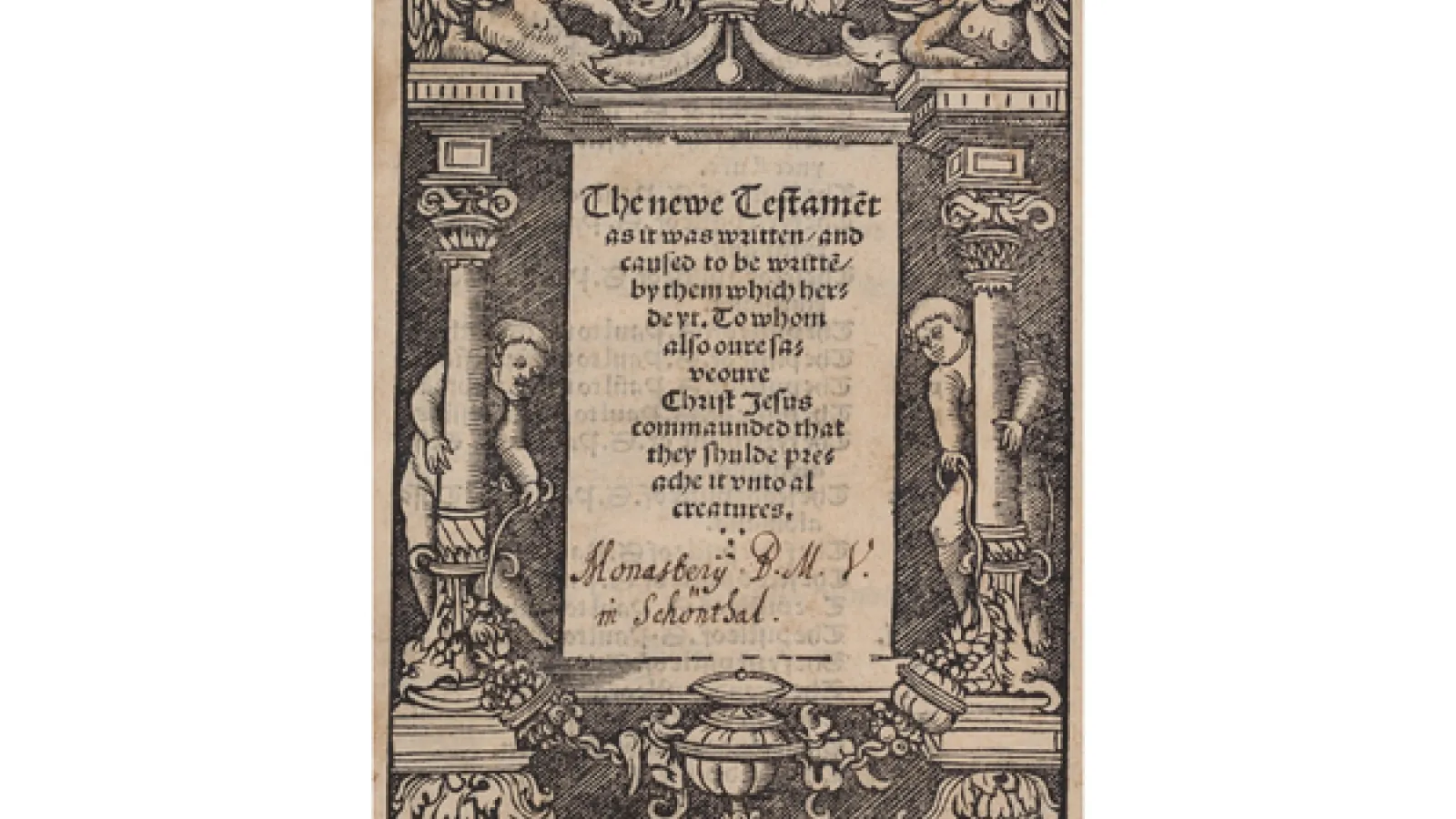
Before the Index of Forbidden Books codified book censorship in 1544, less systematic methods of suppression were used against emergent Protestant texts. The greatest hindrance to our reconstructions of this history is the loss of books, since the burning of censored books left even greater holes in the archive than normal rates of loss. In the case of William Tyndale, whose New Testament appeared 500 years ago, major questions remain about whether and how his work circulated before England broke from Rome in 1534. Re-examining assumptions that have ossified into history, this talk charts new ground upon which to build a history of prohibited books in pre-Reformation England.
Dr. Thomas Fulton is a professor of English at Rutgers University. He writes about the cultural intersections of politics and religion, about problems in rhetoric and generic form, and on the history of reading. His work on Erasmus, Shakespeare, Donne, Milton and other medieval and early modern writers has appeared in several journals and edited collections. His first book, Historical Milton: Manuscript, Print, and Political Culture in Revolutionary England (2010), uses the manuscript record of Milton’s thinking – mainly the reading notes in his commonplace book – to analyze Milton’s rhetorical methods and reading practices in the broader context of early modern methods of reading, note-taking, and writing. A similar set of interests motivates his second book, The Book of Books: Biblical Interpretation, Literary Culture, and the Political Imagination from Erasmus to Milton (2021), which investigates the intersections of biblical interpretation and literary production during the English Renaissance, focusing on such texts as Erasmus’s Education of a Christian Prince, Tyndale’s Obedience of a Christian Man, Spenser’s Faerie Queene, Shakespeare’s Measure for Measure, and Milton’s Paradise Lost.
Co-sponsored by the Center for Medieval and Renaissance Studies, the Center for the Study of Religion and the Humanities Institute.
This event is free, open to the public and welcoming to everyone.
The Humanities Institute and its related centers host a wide range of events, from intense discussions of works in progress to cutting-edge presentations from world-known scholars, artists, activists and everything in between.
We value in-person engagement at our events as we strive to amplify the energy in the room. To submit an accommodation request, please send your request to Nick Spitulski, spitulski.1@osu.edu.